-
 Welcome to Huaxing Technology
-
 Email us: [email protected]


 中文简体

Plush Toy Filling: How Denier, Cut Length and Siliconization Shape Softness
Content
Two plush samples arrive in the same carton: identical shell fabric, identical stitch count, identical 250 g of filling. Three weeks later one still stands upright on a shelf while the other has settled into a lump at the bottom of the belly. In most cases the difference is not how much plush toy filling went in, but how that filling was specified: denier, cut length, crimp and surface finish.
Filling for soft toys is almost always polyester staple fiber, and polyester staple fiber is not one product. A brief that says only "PP cotton" or "polyester fiberfill" leaves the mill free to ship anything between 1.2 D micro fiber and 15 D hollow conjugate. Buyers who name the denier, the cut length and the finish get repeatable softness, loft recovery and washability. Buyers who leave it open get whatever was already in the warehouse that week.
What Plush Toy Filling Actually Is
The stuffing inside a soft toy is short, crimped polyester filament cut to a fixed length and packed loosely. Most of the softness comes from the air trapped between those filaments, which is why bulk per gram usually matters more to the finished toy than price per kilogram.
Hollow conjugate fiber is the workhorse of the category. It is a bicomponent fiber: two polymers are extruded together into a single filament with a hollow channel running through the centre. Because the two components shrink at different rates as the fiber is drawn, a permanent three-dimensional spiral crimp is locked in. The hollow core raises the volume one gram can occupy and gives the fiber a springiness that pushes back after the toy has been squashed flat in a shipping carton.
Six variables decide how that fiber behaves on your stuffing line:
- Denier per filament, the thickness of each individual filament
- Cut length in millimetres, usually 32 mm, 51 mm or 64 mm
- Cross-section: solid, hollow, or hollow conjugate
- Crimp: a mechanical zigzag or the spiral crimp of a bicomponent fiber
- Finish: silicone-treated or non-silicone
- Moisture content and bale compression at the time of shipment
Change any one of them and the same 250 g of filling feels like a different material.
Silicone-Treated or Non-Silicone Hollow Conjugate?
The short answer: if the toy has to feel plush in the hand and recover its shape after washing, specify silicone-treated hollow conjugate. If you need a firmer, denser hand, or you are using the fiber as the base for a bonded blend, a non-silicone grade is the better starting point and usually costs less.
The silicone finish is a lubricant on the fiber surface. It lowers friction between filaments so they slide past one another, fill a narrow arm or ear without bridging, and separate again after compression. That is the property that lets a stuffed toy come back to shape after a wash and dry cycle, and it is also what keeps a stuffing machine running without clogs.
| Criteria | Silicone-treated hollow conjugate | Non-silicone hollow conjugate |
|---|---|---|
| Surface slip | Low friction; filaments slide and redistribute easily | Higher friction; filaments grip one another |
| Loft per gram | High, with quick opening during carding or blowing | Slightly lower; packs more densely |
| Recovery after compression | Springs back readily, including after transit | Holds position, recovers more slowly |
| After washing and drying | Generally re-lofts instead of matting | Can clump or mat, depending on crimp |
| Best used for | Soft toys, machine-stuffed limbs, washable plush | Firmer bodies, bonded blends, heat-set structures |
Non-silicone fiber grips itself more strongly. That produces a slightly firmer feel and a filling that stays where it is placed, which some buyers prefer for structured toys, weighted bases or blends that must not shift during heat setting.
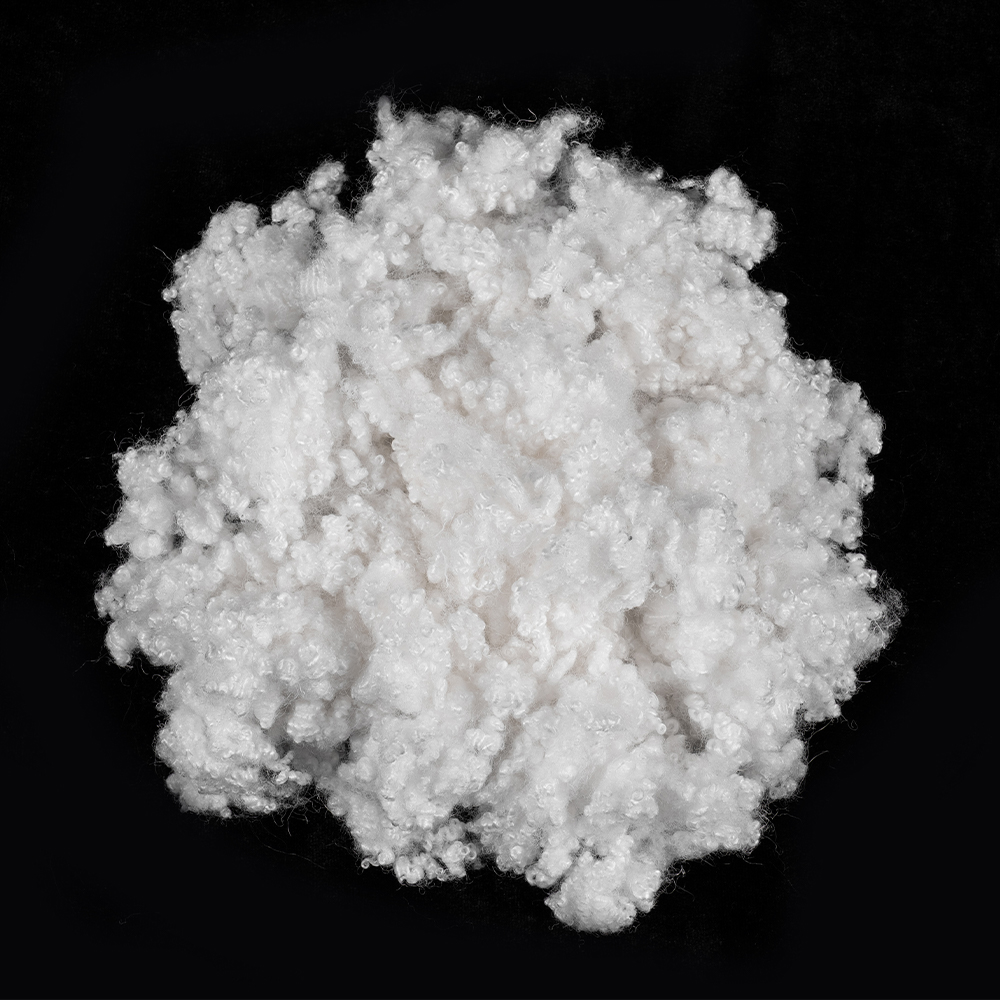 7D HCS Silicone-Treated Polyester Staple Fiber for FillingSilicone-treated hollow conjugated 7D polyester staple fiber for quilts, sofas, pillow cores, apparel, and plush toys, balancing softness, loft, support, and durability.View Product →
Reading Denier and Cut Length
Denier is the weight in grams of 9,000 metres of filament, so a higher number means a thicker filament. In filling, that single number drives most of the hand feel:
- 1.2 D to 3 D: fine filaments, dense and smooth. Used for small plush, faces and surface layers where an even hand matters.
- 7 D: the general-purpose middle ground, found in the body of most medium teddy bears and soft toys.
- 15 D: coarser and springier, giving high loft per gram. Suited to large plush and cushions that must look full with less weight.
Cut length works in the opposite direction. A 32 mm cut packs more densely and feeds easily into small limbs; a 64 mm cut is loftier and fills large cavities faster. Most plush filling sits at 51 mm or 64 mm, with shorter cuts reserved for smaller items.
Watch the letters in a supplier's code. Suffixes such as HC, HCS or H are used to mark the cross-section and the treatment, but naming is not standardised from mill to mill, so confirm the definition in writing before you approve a sample. A 7 D, 64 mm non-silicone grade, for example, is a common starting point when a toy needs a firmer body and a fill that stays where it is placed.
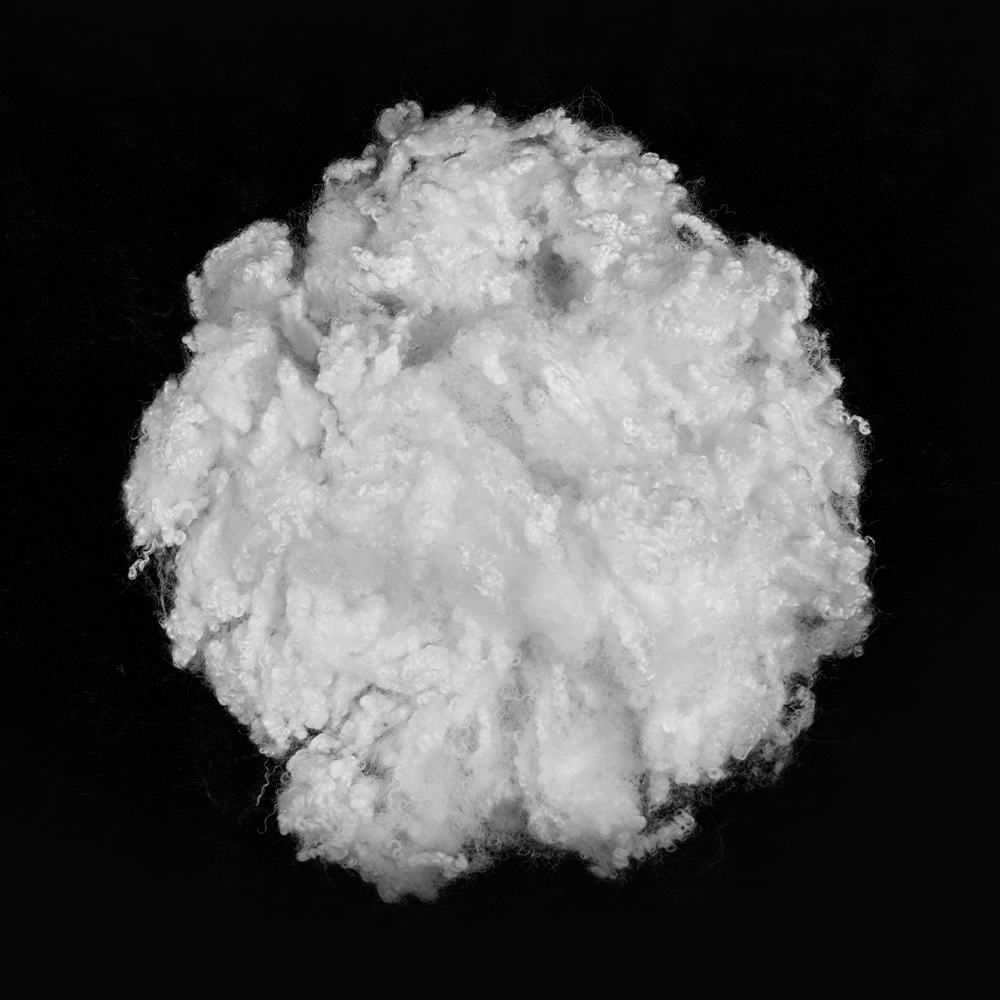 7D x 64mm HC Non-Silicone Polyester Staple FiberNon-silicone hollow conjugated 7D x 64mm polyester staple fiber for comforters, sofas, pillow cores, apparel, and plush toys needing firmer, cohesive filling.View Product →
Low-Melt Fiber and Bonded Blends
Some plush products cannot tolerate a filling that shifts. Weighted bases, moulded seat inserts and toys with long thin limbs all suffer when loose fiber migrates to the bottom.
Low-melt fiber solves this without glue. It is a bicomponent staple fiber with a sheath that softens at a temperature well below the melting point of the core. Blended with standard filling and passed through a heat tunnel, the sheath bonds to neighbouring filaments at their contact points and forms a light three-dimensional network. The result is a filling that keeps its loft through repeated compression and stays distributed across the whole toy.
It is supplied in grades such as 2 D 51 mm, 4 D 51 mm H and 4 D 64 H mm, and can also be used on its own for a firmer interior or as a thin layer just behind the shell. At the other end of the scale, micro fiber down at 1.2 D gives a smooth, dense surface feel and is often the fiber people are describing when they say a toy feels velvety inside.
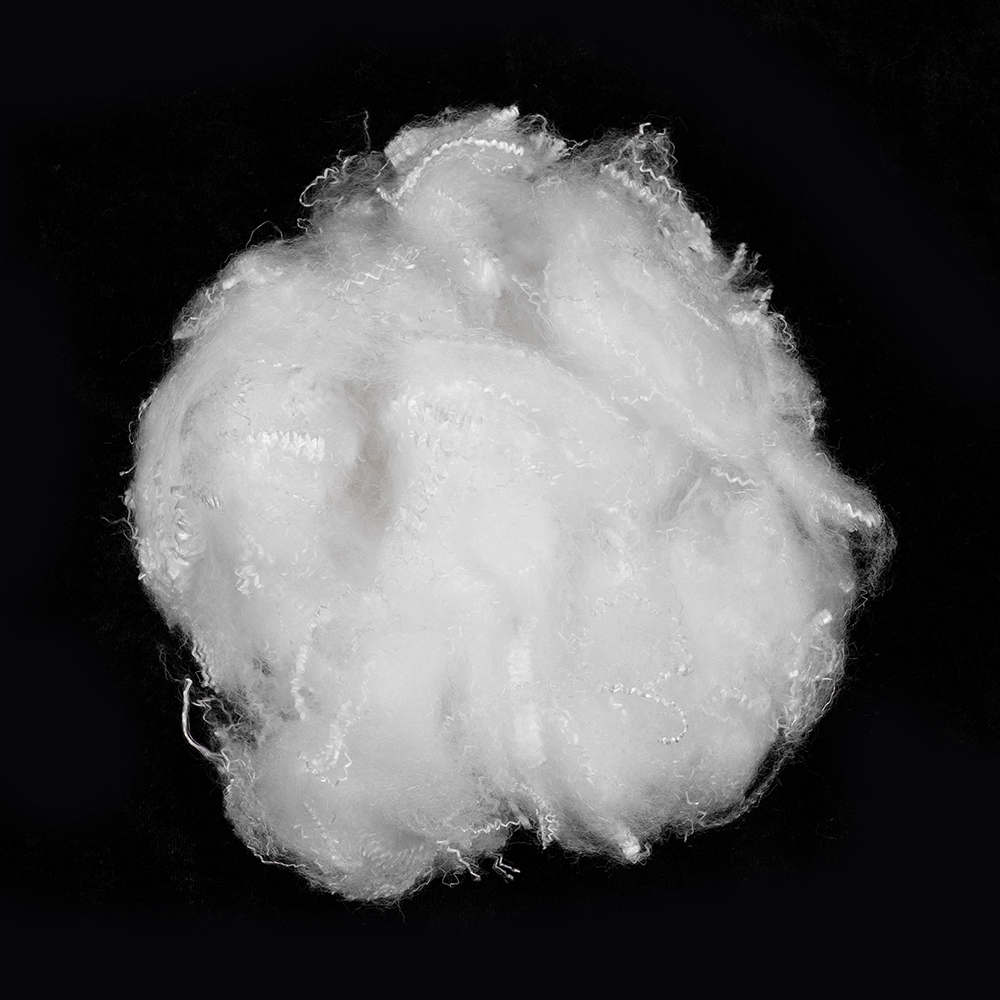 2D x 51mm Polyester Staple Fiber for Thermal BondingFine 2D x 51mm polyester staple fiber for thermal bonding, nonwovens, home textile filling, sofas, mattresses, and automotive interior applications requiring softness and conformability.View Product →
Loft, Weight and Five Sourcing Mistakes
Filling problems in plush almost never show up in the sample room. They show up three weeks after the container lands, and they trace back to the same handful of causes.
- Quoting by price per kilogram alone. Two fibers with different bulk need different masses to fill the same volume, so the cheaper kilogram is not automatically the cheaper toy.
- Under-stuffing to hit a target weight. Polyester settles, so a toy that looks right on day one can look limp by the time it reaches the shelf. Fill to firm, then re-check after a compression cycle.
- Assuming every fiberfill is washable. Crimp and finish decide how the filling behaves after a wash and dry; non-silicone or low-crimp fills can mat into clumps.
- Ignoring moisture content and bale compression. Damp or crushed fiber needs more mass to reach the same loft and can develop odour in transit.
- Approving a sample without keeping a reference. Seal a bag of the approved material, label the denier, cut length and finish, and attach it to the purchase order.
How to Write a Filling Specification You Can Quote Against
A workable filling specification is short and specific. It should cover:
- Base polymer and cross-section, for example hollow conjugate polyester staple fiber
- Denier per filament
- Cut length in millimetres
- Finish: silicone-treated with the treatment level stated, or explicitly non-silicone
- Crimp type plus a bulk target expressed as volume per unit mass, not as a word like soft
- Moisture content limit, bale compression and packaging
- A retained sealed sample and a wash-and-dry criterion applied to the finished toy
If you are still narrowing down which hollow conjugate grade suits a particular toy, our guide to choosing hollow conjugate fiber filling materials walks through the trade-offs in more detail.
Frequently Asked Questions
Is polyester fiberfill safe for children's plush toys?
Polyester staple fiber is the standard filling for soft toys worldwide. What matters is cleanliness rather than the polymer itself: no metal, glass or hard debris, no contamination picked up on the production line, and the test reports that apply to your destination market. Ask what screening and metal detection the filling line uses, and keep the reports on file.
Can plush toy filling be washed and dried?
Yes, provided the fiber is specified for it. Silicone-treated hollow conjugate generally recovers better after a machine wash and tumble dry because the filaments can slide apart again, while non-silicone and low-crimp fills are more likely to mat. Seam strength and drying temperature still decide whether the toy survives, so test the finished item rather than the fiber alone.
How much filling does one plush need?
There is no universal gram figure, because the number changes with denier, loft and the firmness you are targeting. Work backwards from volume instead: stuff a reference toy to the firmness you want, weigh the fiber that went in, and treat that as the target for the same pattern and the same grade.
Plush toy filling is made upstream of the toy factory, and the fiber mill behind your supply is worth knowing. Ningbo Huaxing Technology has been producing polyester fiber since 2001 from a 185,000 square metre site, with nine independent patents, an engineering technology centre and more than 20 senior specialists. In 2012 the company invested over RMB 300 million in a line producing 160,000 tonnes of high-quality POY polyester filament a year, using direct esterification and direct spinning with fully automated spinning and winding equipment.
The catalogue covers the range behind the filling discussed here: hollow conjugate polyester staple fiber in both silicone-treated and non-silicone versions, low-melt and micro fiber staple, polyester chip and POY filament. If you are matching a denier and cut length to a specific toy, send us the brief and a reference sample and we will come back with the closest grade.
-
Quick Links
Home About Us Products FAQ News Contact Us -
Product Links
Polyester Staple Fiber Pre-oriented Yarn/POY Polyester Chip/PET Chip -
About Us
About Us Factory Honor FAQ -
Get In Touch
E-mail:
[email protected]Phone:
+86-130 8198 6637Tel:
+86-0574-63732888Address:
Haidianrong Village, Longshan Town, Cixi City, Ningbo, Zhejiang Province, China.
